Arcamed logo
Contact

Insights that Drive Progress

How Arcamed views operational excellence.

Benefit of a specialized manufacturer

Benefit of a Specialized Manufacturer: How a "One-Stop-Shop" Supplier Sets you Back

The idea of a "one-stop-shop" supplier can seem attractive. On the one hand, companies can work with fewer vendors and a single point of contact – appearing to offer a simpler way to manage project launches. However, the breadth of an operation can often overshadow the real result of a multi-faceted supplier: a failure to deliver consistent, high-quality results.

When a supplier divides its attention across multiple production lines and manufacturing markets, customers start to feel the strain on the back end. Slower communication, inconsistent investments, and competing priorities can weaken partnerships. A supplier may be capable of producing a range of products without delivering the consistency and excellence customers depend on.

A specialized manufacturer offers a different experience—one built around focused expertise, deliberate investment, transparent communication, and the flexibility to support changing customer needs. 

I have been very impressed by Arcamed’s approach to partnering and aligning with customer business needs. Their innovative investments, flexible capacity, transparent communications, and outstanding internal culture ensure the whole Arcamed team executes at an elite performance level.  Plus, customers don’t get lost at Arcamed as their core competency, and 100% focus is on delivering Case & Trays enabling successful new product launches and day-to-day production deliveries that can be counted on

Howard Levy - Former VP Global Sourcing, Zimmer Biomet and Arcamed Board Member

Specialization & Investment

Becoming an elite supplier does not happen overnight. It takes years of deliberate investment in training, technology, and industry knowledge.

As a dedicated case and tray manufacturer, Arcamed is positioned to focus its people, equipment, technology, and improvement efforts on the needs of the case and tray market. There is no long list of unrelated divisions competing for capital. At Arcamed, investments are made to increase case and tray capacity, improve quality, reduce cost, and support customer growth. Specialization ensures that investments create long-term value rather than short-term fixes.

New technology and process improvements – including advanced CNC machining, AI-enabled tools, and workforce development – are selected and implemented based on their ability to improve customer outcomes. Each investment is intended to make project launches easier, production more consistent, and delivery more dependable.

Capacity & Capability Transparency

Longstanding supplier partnerships are built on an honest understanding of what a supplier can deliver. Arcamed builds strong partnerships through clear communication of available capacity, project timing, capabilities, risks, and performance. This level of transparency helps customers address pain points early and operate with peace of mind.

Capabilities matter, but dependable execution matters more. A supplier may advertise an extensive list of services but may be hesitant to show results. The burden of discovery should not be placed on customers who need to know that a supplier's capabilities are properly staffed, maintained, prioritized, and reliable. Transparency separates what a supplier can promise from what it can consistently deliver.

With Arcamed's clear capacity and performance commitments, as well as the public publication of our performance metrics, customers are given a clearer understanding of project readiness and production reliability. The goal should not simply be to say yes to every request, but rather to understand customer needs and supplier capability.

Remaining Flexible

Operating in a versatile supply chain means successful suppliers are able to plan and adapt to changing conditions. Balancing market changes and customer demand can stretch a supplier thin when not flexible. "One-stop-shop" suppliers can be worn down trying to allocate resources throughout their divisions, often pushing case and tray operations to the back.

Arcamed is not only focused on the products it creates, but also on the partnerships it fosters and the promises it makes. Because its people, equipment, and systems are centered on case and tray manufacturing, the team can respond to changing customer priorities or supply chain shifts without drawing attention away from another division.

Focus Delivers More Than Breadth 

The value of a supplier should not be measured by capabilities alone, but also by the consistency of results it achieves.

A specialized manufacturer can invest more intentionally, respond more quickly, communicate more clearly, and build deeper knowledge within its market. That focus helps customers launch programs accurately, maintain dependable production, and navigate changing business conditions with greater confidence.

Arcamed’s commitment to case and tray manufacturing allows the entire organization to remain aligned with customer needs. Through focused investment, transparent capacity planning, specialized expertise, and operational flexibility, Arcamed delivers more than manufacturing capability. 
Read More
How Arcamed Delivers Consistency in a Dynamic Supply Chain

Remaining Reliable: How Arcamed Delivers Consistency in a Dynamic Supply Chain

Throughout its 15-year history, Arcamed has undergone extreme growth in the face of unstable industry conditions. It’s not always easy to stay on top of a supply chain poised to wear suppliers down. The key to their success is poetically simple: an unwavering discipline to remain true to delivering the right productson timewith exceptional service.

“Promises made are promises kept” is the mantra of many supplier partnerships, but unfortunately, it is not often the case. In the highly competitive medical manufacturing market, there is a constant battle to acquire new business. This drives some suppliers to over-promise at low cost and under-deliver with inconsistent results.

Some suppliers will always say ‘yes’. It becomes our job to understand whether they actually have the capacity to deliver 

- Customer Testimonial 

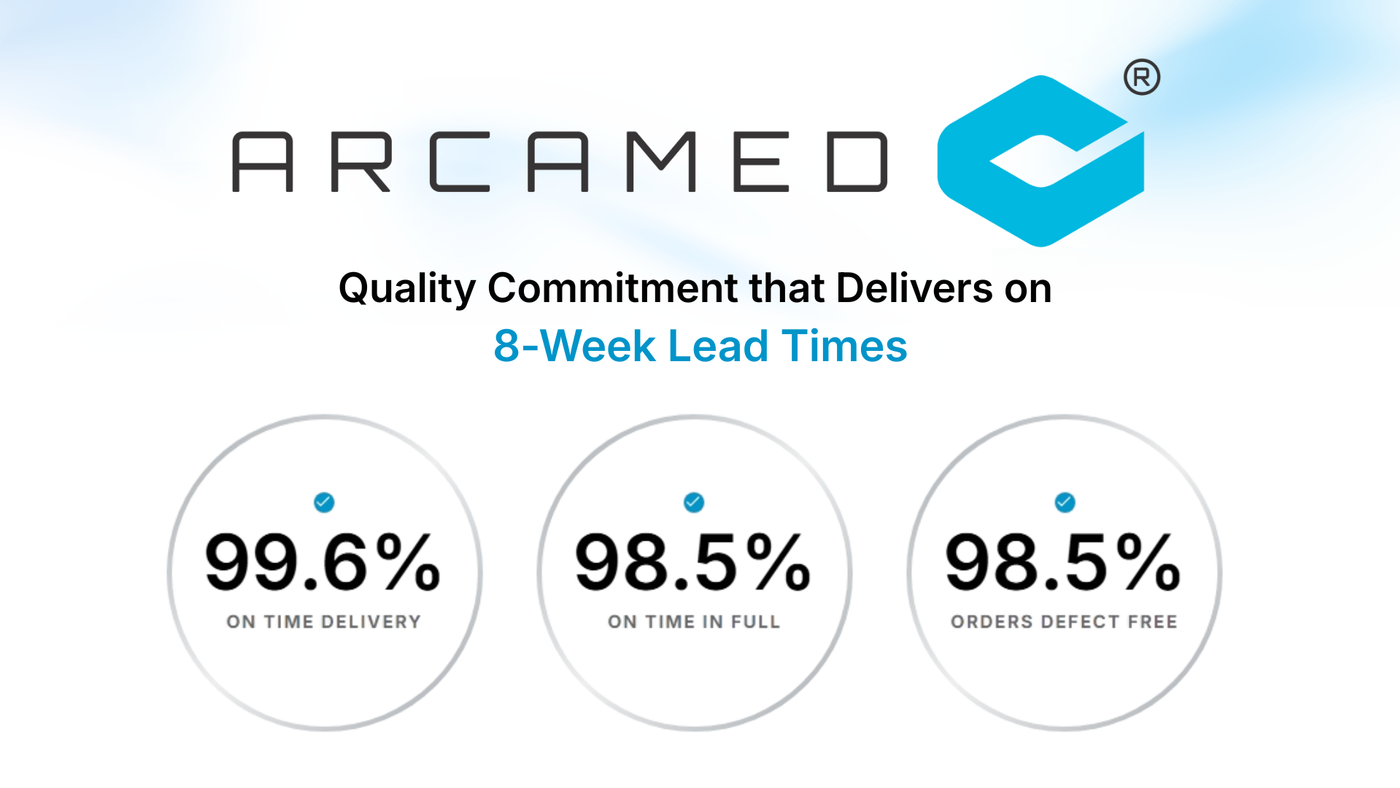
With humble beginnings, Arcamed knew that in order to grow they needed to build trustworthy partnerships. The method? Remain reliable and always improve. Arcamed recognized that becoming successful in a versatile supply chain means staying valuable during fluctuating conditions. They saw available capacity as an opportunity to reinvest in their workforce and operations, not a time to cut costs. The payout was clear. Not only have they achieved consistent 8-week lead times at a competitive price, but with 99.6% OTD98.5% ODF, and 98.5% OTIF, they’ve built a reputation as a dependable partner.

Every supplier must balance price, quality, and speed. Often, improving one comes at the expense of another. Arcamed recognized this tradeoff and made an uncompromising decision: deliver on every promise. Rather than cutting costs to lure customers in, they have invested in systems that perpetuate industry-leading quality and delivery metrics. Successful partnerships are built on trust, not attractive headlines. Arcamed has established itself as a consistent provider of elite value at all times, not just when the industry is slow. That's what it means to deliver boring excellence.

Read More
Customer Collaborated Designs for Manufacturability

Starting Fresh, Not Starting Over: Arcamed’s Seamless Design Transfer Process

When does familiarity stop serving your business and start holding you back?  

For Original Equipment Manufacturers (OEMs), that can be a hard question to answer. A long-standing supplier relationship may feel stable, even when warning signs emerge – rising costs, late deliveries, lacking quality, or poor communication. The perceived pain of changing suppliers shouldn’t keep you from finding a better partner. Trustworthy partners consistently maintain industry-leading delivery metrics for quality products that OEMs can trust. Shifting suppliers post-launch can be high-risk and high cost, but with the right partner, project momentum doesn’t need to stop. 

One of the greatest challenges in supplier transition is the significant burden placed on them to validate product equivalency. This involves risk associated with interpreting legacy prints, ensuring feature alignment, and confirming that critical characteristics are not lost in translation during supplier changeover. Arcamed has invested in a streamlined, low-risk transfer process built around a core principle: shift the validation burden from the customer to our internal process while minimizing risk to zero. 

Design Transfer Pathways 

Arcamed utilizes three primary design transfer pathways depending on the level of data provided upon transition. Each pathway is designed to meet the project where it stands in the manufacturing cycle and move it forward efficiently. 

  1. Full Data Package (CAD + Complete Prints): Direct import of CAD into manufacturing systems with use of customer prints for production and inspection 
  2. Assembly-Level Data (Assembly CAD + Assembly Prints Only): Direct import of CAD into manufacturing systems, use of customer assembly prints for production and inspection, and Arcamed generated component prints to pair with customer provided assembly prints 
  3. CAD-Only Transfer: Direct import of CAD into manufacturing systems, Arcamed generated assembly prints, and Arcamed generated component prints that require customer engagement for: Critical parameter clarification and tolerance requirements for functional compatibility 

Model-Based Manufacturing Process 

Arcamed is committed to picking up your project where it was left off. Whenever possible, the process begins with the CAD model in conjunction with released prints. CAD models, or computer-aided designs, are digital models of projects. Our expert team of engineers adopts the CAD model design and, with the use of Cloud NC, streamlines programming and optimizes the manufacturing process. This ensures: 

  1. Alignment with the original design intent. 
  2. Consistency in feature interpretation and inspection methodology. 
  3. Elimination of translation-induced variability. 

Transferring to a new supplier shouldn’t mean starting over. Through our legacy integration process, we maintain consistency without sacrificing momentum. By producing and inspecting against the same technical data package as the incumbent supplier, Arcamed effectively removes equivalency risk from our partners. 

Early Capability Assessment 

Effective design transfer processes require a structured intake and evaluation process to prevent downstream risk. To achieve this, front-loaded technical diligence is required. 

The process begins with our cross-functional team of subject-matter experts (SMEs), including manufacturing, quality, programming, graphics, and engineering, reviewing all incoming data packages. Together, the team conducts a comprehensive feasibility assessment, which includes: 

  • Materials 
  • Tooling  
  • Inspection 
  • Assembly techniques 

From this assessment, a formal decision is made on whether the opportunity can be executed to specifications. To date, Arcamed has been awarded 100% of design transfers since the program's installation.  

This process informs our team of all technical gaps internally, allowing us to resolve any issues without requiring iterative clarification cycles with the customer. 

Transparency 

Strong partnerships are built on trust, and trust is built through transparency. 

At Arcamed, we make our performance visible by publicly releasing our live OTD, OTIF, and ODF metrics. This gives current and potential partners a clear understanding of what delivery standards they can expect. If any operation is delayed due to supply chain constraints or a similar issue, customers are informed promptly to ensure communication remains proactive, direct, and honest. 

Throughout the design transfer process, partners are connected with a dedicated project engineer who serves as a consistent point of contact. This creates a clear communication channel for critical updates, technical questions, and issue resolution without unnecessary noise. 

The Result 

Arcamed’s structured design transfer process enables OEMs to seamlessly transition suppliers with minimal disruption beyond improved performance. From a technical standpoint, the design intent, quality expectations, and functional performance remain unchanged – ensuring continuity without compromise.  

Customers retain ownership of their prints and products while gaining a supplier who consistently delivers an 8-week production cycle at 99.1% on-time delivery, 98% on-time-in-full, and 97.5% order-defect-free performance. 

The decision to change supplier is not an easy one, but with the right process and the right partner, design transfer can become more than a recovery plan—it can become a strategic advantage. 

Read More
Arcamed Apprenticeship and Career Development Program

Apprenticeship Programs: Conexus Indiana's Analysis of Arcamed's Career Development

About Conexus Indiana

Conexus Indiana is a nonprofit organization dedicated to the progress of Indiana as a global leader in advanced manufacturing and logistics. Conexus Indiana brings together companies to adopt new technologies, support workforce development initiatives, and foster collaboration to identify challenges and highlight the success in advanced manufacturing and logistics. Conexus plays a vital role in cultivating rewarding career opportunities for Hoosiers while maximizing the state's economic potential. This article is an interview-analysis published by Conexus Indiana and conducted between Conexus Indiana and Arcamed President and CEO, Jon Desalvo.

Learn more about Conexus Indiana's contributions to advanced manufacturing and logistics and find the full Conexus Indiana article here:

https://ow.ly/KVOZ50YgC9V

How Apprenticeship programs can thrive in Hoosier advanced manufacturing and logistics companies: advice from a successful CEO

Posted in Blog Post by Conexus Communications on February 13, 2026, and is republished with permission.

Since 2012, Indianapolis-based Arcamed has been designing and manufacturing surgical case and tray systems. For nearly a decade, under the leadership of CEO Jon Desalvo, the company also has maintained an active apprenticeship program. Currently Arcamed’s workforce of 85 includes 10 apprentices. Over the years, some 40 high school students have worked and learned as Arcamed apprentices and, adding students working toward associate degrees and 4-year college degrees, Jon estimates that number grows to 70 or 80 apprentices.

With his experience and enthusiasm for the Arcamed apprenticeship program, it’s no surprise that Jon is actively involved in a statewide effort to transform how students and adults prepare for high-demand careers in advanced manufacturing and logistics (AML). As chair of the AML Industry Talent Association (ITA) that Conexus Indiana leads, Jon works alongside fellow employers to help define the skills and competencies students need, co-create curriculum and ensure training aligns with real workforce needs.

From that vantage point, Jon believes that not enough companies are teaching students and their parents about what manufacturing companies in Indiana can offer. “With more than 9,500 manufacturing companies in Indiana, that’s our bread and butter. That’s what we do,” he said. And he’s happy to share some of the lessons he’s learned as Arcamed developed its apprenticeship program:

  • *Start with “Can” rather than “Can’t” — “*There are so many fabricated barriers. Our mission became ‘We’re going to say we can and figure out a way.’”
  • Develop an onboarding program that helps apprentices succeed from the first day.  “Think about onboarding at a high school level. Showing where the restrooms are, clocking in and out. Our quality manager made a video explaining what his job is and what concerns they should bring to him. Think about all the how-to things and close all those little pockets of information a new hire needs to know.”
  • Make ‘show up skills’ the first lesson. — “’You have to show up every day committed, because we are committed to you. You’re going to have a voice. This is what is expected of you when you come through that door. You are not an apprentice or a journeyman or a student. You are an employee.’ Explain what is expected every single day: your company values, accountability, communication, attitude.”
  • The learning goes both ways. — “A lot of times we put age limits on things that aren’t deserving. For instance, in the age of new technology, you may hear a student educating the mentor: ‘Why don’t you put that in AI? Here’s what it will give you.’ And then they show them. The learning goes both ways and that’s the beauty our organization has really embraced.”
  • Your apprenticeship program is a philanthropic community partnership. — “It’s hard to find good people, and it’s hard for students to find ways to learn skills needed to achieve good jobs. If we’re not hiring, learning and teaching, how are we going to create outstanding people in AML? For me, there is no greater satisfaction than seeing a student using Arcamed as the launching pad for their career. “
  • Top leadership must be committed to see your program succeed. — “If they’re not, it’s a battle you can’t win. There’s no secret recipe that makes this work. It’s not a one-size-fits-all, and you will fail in some instances. You learn from your failures and create different processes.

It’s gratifying for Jon to see how invested the Arcamed workforce has become in training and mentoring the young apprentices. and to see the bonds that have been forged between apprentices, mentors and the company — the way they stay in touch with former mentors after an apprenticeship ends, for instance.

Mentors have learned a great deal from their apprentices, too, and Jon believes that effect will be reflected in your own program. “You will be blown away at how much these kids know and the work ethic they come with when it’s something they want,” he said. “This generation of high school students are getting fulfillment from working. It is amazing the immediate value and impact they have on the company. It really is.”

About the Indiana Career Apprenticeship Pathway (INCAP)

The Richard M. Fairbanks Foundation provided grant funding beginning with the Modern Youth Apprenticeship pilot in 2020 and has continued investing in workforce innovation through iLab Indiana — a coalition of 300+ state business, education, nonprofit and government leaders committed to reimagining career learning and training.

Through that coalition, Indiana leaders designed and are now building the Indiana Career Apprenticeship Pathway (INCAP), an employer-led, Swiss-inspired apprenticeship system that blends classroom learning with paid, on-the-job training starting in high school and extending into adult career advancement. INCAP partners with employers through Industry Talent Associations (ITAs) to help define the skills and competencies students need, co-create curriculum and ensure training aligns with real workforce needs. The Fairbanks Foundation continues to support creation of ITAs, regional implementation infrastructure, student recruitment and employer engagement — all aimed at building scalable and sustainable pathways so Indiana can rain, retain and grow talent at scale.

Read More
View All Insights